


Be Here
- Marissa Galvan

- Sep 2, 2025
- 5 min read
This is the sermon preached by Pastor Marissa for August 31, 2025, based on Luke 14:1, 7-14.
A Tale of Two Banners
Recently, the Hong family replaced the old banner outside our church with a new one. That banner carries an important story. David LaMotte, a songwriter, speaker, and peace activist in the Presbyterian Church, has spent more than three decades using his gifts to invite people to reflect on justice, reconciliation, and hope.
In 2016, as he tells it, he was deeply troubled by the divisions he saw in the United States. So he decided to create a simple banner for his own front yard in Black Mountain, North Carolina. It read: “No matter where you are from, we’re glad you’re our neighbor.” He translated it into Spanish and Arabic, and soon neighbors began asking for copies. Eventually, he made them more widely available, expanding the words to say:

You are our neighbors. No matter who you vote for, the color of your skin, your faith, or who you love, we will try to be here for you. That’s what community means. Let’s be neighbors.
The message seems simple, rooted in hospitality. It does not erase our differences, but it proclaims a basic truth—that every person is welcome, and every person is a neighbor. In a time of polarization, the banner has become a visible sign of God’s call to love the stranger and extend peace across lines of language, culture, and nation.
But is it really that simple? Can we just put up words like that and assume we will live up to them? Will people believe what we say?
This banner reminded me of another story I saw in the news. A man in North Carolina put up a banner in his yard that read: “Build the Wall: Deport Them All. Trump, start with my neighborhood first.” When interviewed, he admitted his sign was directed at his own neighbor, a Latino man—a legal U.S. citizen—who owns a garage near his property.

Two banners. Two very different visions of what it means to be a neighbor. Two very different understandings of hospitality. And still, one deeply divided nation—where words matter, and where we must be responsible for both the words we speak and the commitments we make.
A Parable
The passage for today tells us that Jesus was going to the house of a leader of the Pharisees to share a meal. While he was there, he noticed how the guests chose the places of honor. This was not unusual. In Palestinian culture, the center couch was the place of honor, and the men seated around it were chosen according to wealth, power, or position. If an important man arrived late, someone of lesser rank was asked to move to a less prestigious seat. Jesus is offering very practical advice: choose the lowest place so that you may be invited higher, rather than the other way around. Can you imagine? ¡Qué vergüenza!—How embarrassing to be asked to move down!
As guests, then, we should not rush to the head of the dining table, but instead choose a humbler place. If we are invited to sit closer to the host, that is a blessing. But we should not think of ourselves as better than others, nor should we see ourselves as less worthy than others. Humility matters. As Proverbs teaches: “Do not put yourself forward in the king’s presence or stand in the place of the great; for it is better to be told, ‘Come up here,’ than to be put lower in the presence of a noble.”[1]
But Jesus’ words are not only for the guests; they are for the host as well. He reminds the host not to invite those who can repay him, but to invite the poor, the crippled, the lame, and the blind—those who can offer nothing in return. Why? “And you will be blessed, because they cannot repay you, for you will be repaid at the resurrection of the righteous.”
This is the great reversal of the kingdom of God. This is the redefinition of hospitality that Jesus taught—not only to the powers and principalities, but to his disciples. And these are the lessons we still need to learn today.
Real Hospitality
Brandon Ambrosino, in an article he wrote, says that parables are told “to shock us, to wake us up, to force us to question our own moral superiority.” So what does this parable tell us about how to be hospitable—and how to live up to the values of the banner we have chosen to place outside our church building?
Charles Raynal, reflecting on the theologian Karl Barth, reminds us that Christian hospitality is not just about being polite or welcoming. It is about living out the fellowship that God has already created in Jesus Christ. In Christ, God has made peace with humanity, and the church is called to show that peace by building true fellowship with one another.
Barth points to four ways this fellowship takes shape in the life of the church:
When we reach out to people of every nation, we show that God’s love breaks down walls of language, culture, and nationality.
When it comes to race, the church cannot divide itself into “white churches,” “Black churches,” or “brown churches.” In Christ, we are one body.
When we gather across cultures, we do not simply “bless” our differences, but we allow God’s Spirit to unite us as one family of faith.
And in our care for one another, we set aside the world’s divisions of rich and poor, remembering that at Christ’s table, all are equal .[2]
So when we place this banner outside, we are making a commitment. We are committing ourselves to live as a sign of God’s fellowship in Christ—breaking down walls of nation, race, culture, and class—so that the world may see in us a community where all people belong, and all are equal at the table of God’s kingdom. No matter who they vote for, their skin color, their faith, or who they love—we commit to try to be here for them.
That is what community means. That is what hospitality means. That is what God’s kin-dom, God’s family, truly is.
The Tale of Our Banner
I’m sure you have seen these signs around.
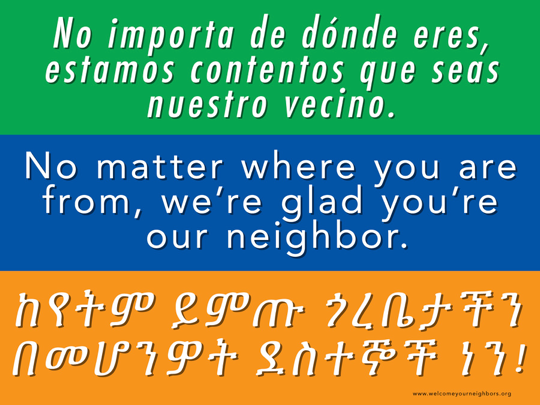
They remind us of that first banner David LaMotte made for his home. Here at Beechmont, we have been making banners for our church and placing them out front—and now we have a brand new banner, soon to be joined by its Spanish-language companion.
So, as we reflect on this parable today… what will our personal banners say? Who will we invite to our table? Where will we choose to sit? Will we choose humility? How will we be neighbors? How will we live out true hospitality?
Let’s be honest: it is hard to invite someone to our table who voted differently than we did. It is hard to welcome someone who doesn’t come from the same place we do. It is hard when they do not share our faith, or when they speak about God in ways different from our own. It is hard when their identity or their expressions of love are not what we grew up with.
But… what God calls us to do—and who God calls us to be—is a family where all people belong, even when it is hard.
So what banner do you think God would want us to place in our front yard?

May God help us to live as Jesus lived,
to speak as Jesus spoke,
and to love as Jesus loved.
Amen.
[1] Rodney S. Sadler Jr., “Exegetical Perspective,” in Feasting on the Word: Preaching the Revised Common Lectionary: Year C, ed. David L. Bartlett and Barbara Brown Taylor, vol. 4 (Louisville, KY: Westminster John Knox Press, 2010), 23.
[2] Charles E. Raynal, “Pastoral Perspective,” in Feasting on the Word: Preaching the Revised Common Lectionary: Year C, ed. David L. Bartlett and Barbara Brown Taylor, vol. 4 (Louisville, KY: Westminster John Knox Press, 2010), 22–24.


Comments